Deep Work Is Down to 39% of Your Day
There was a stretch of years, at a fully remote agency, where I regularly worked 60-hour weeks. We called ourselves an async team. It was in the onboarding deck. Work when you work best, reply when you can, we trust you with your own time.
Except there was a clock running underneath it. A time limit from when a message came in to when you were expected to reply – internal messages, client messages, didn’t matter which. Async in name. Synchronous in every way that pressed on you. I’d be mid-thought on something that needed real attention, feel the phone buzz, and know the countdown had started whether I looked at it or not.
That’s not a willpower problem. Nobody in that building lacked discipline. What we lacked was a system that let the work we were being paid to think about actually get thought about.
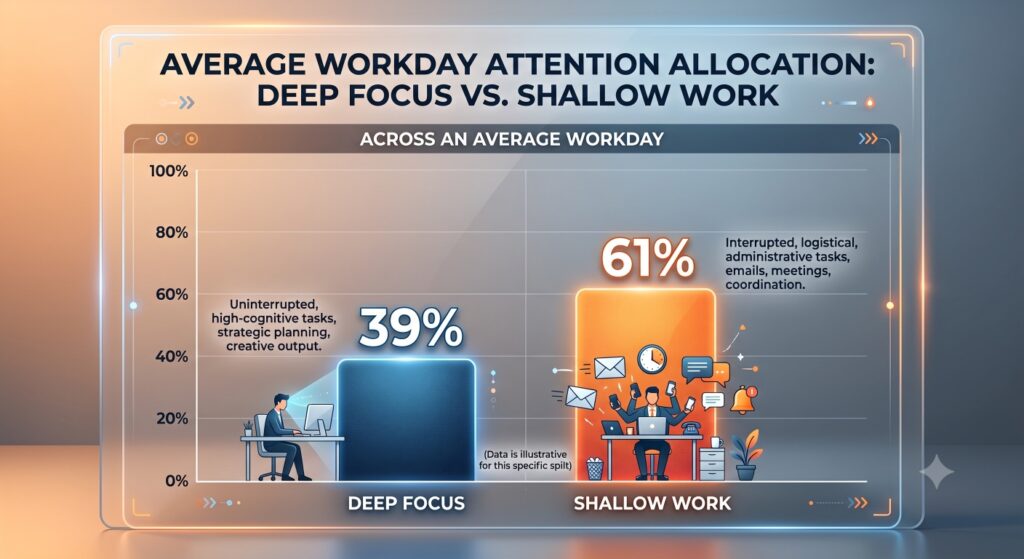
Table of Contents
- The number is 39%, and it’s not the whole story
- Why the gap between meetings hurts more than the meetings do
- Why “just block your calendar” isn’t the fix
- “Async” that isn’t actually async
- Meetings as the cover charge for looking busy
- What actually works, because someone already tried it
- What this actually asks of you
- FAQ
- What’s a reasonable response time for internal messages versus client messages?
- Can task-tracking tools like ClickUp or Asana actually replace status meetings?
- How do you tell a manager or client you need uninterrupted time without it looking like you’re avoiding collaboration?
- Why do collaborative roles like project managers get less deep work than technical roles?
- Does working remotely automatically protect focus time better than being in an office?
- Does AI reduce meeting and communication overload, or add to it?
- Are no-meeting-day policies actually effective, or do they just push meetings into other days?
The number is 39%, and it’s not the whole story
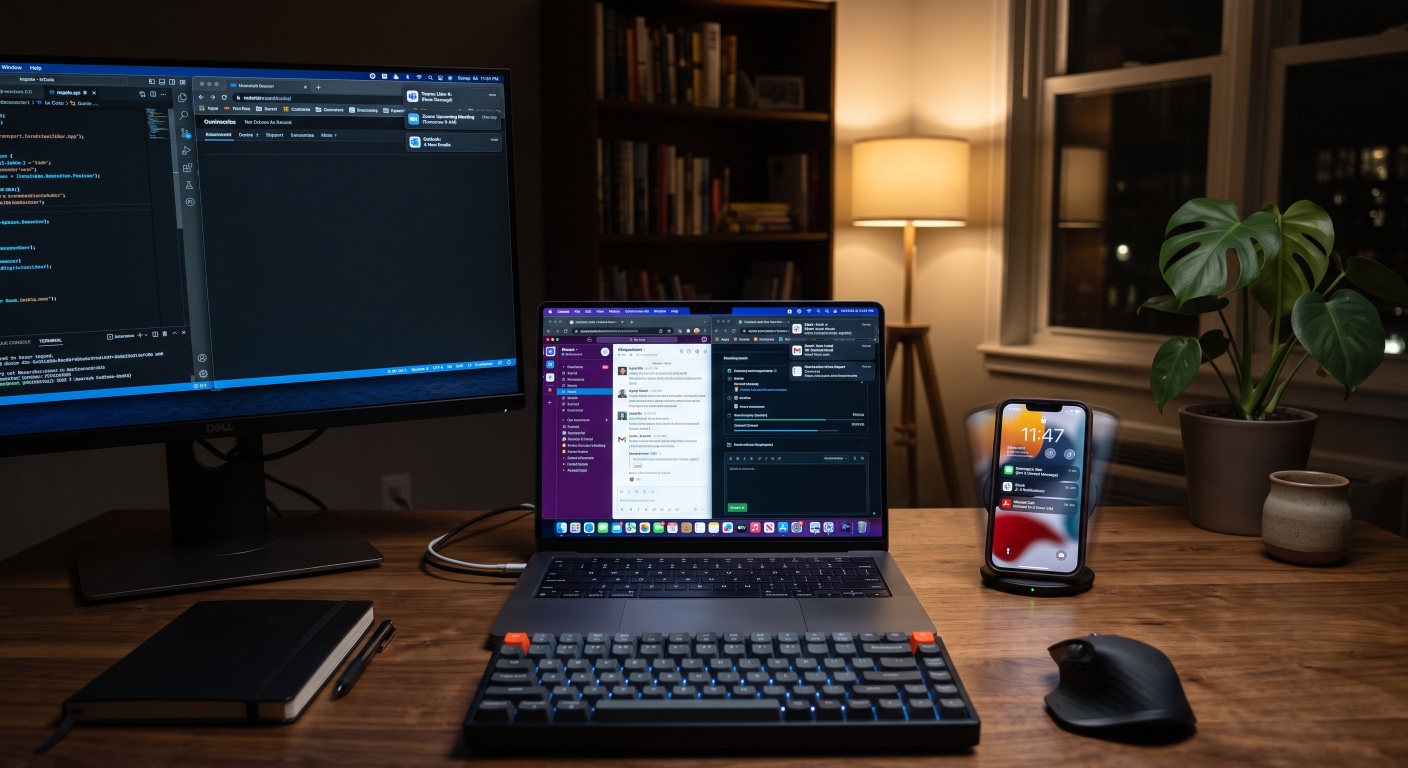
Hubstaff’s 2026 Global Work Index tracked more than 140,000 workers across 17,000 organisations and landed on this: the average employee spends about 39% of their tracked time in deep focus. Roughly two to three hours out of an eight-hour day. The rest goes to meetings, messages, admin, and the dead time between one task and the next.
Deep work, in Hubstaff’s framing, is the stuff that requires your brain – analysing data, writing something that matters, learning a new system, solving a problem nobody’s solved for you already. Shallow work is everything else. Answering emails. Updating a tracker. Sitting in a meeting that could have been three lines in Slack. Shallow work isn’t the enemy. It’s necessary. The problem is that it expands to fill whatever space you give it, and most workplaces give it almost the whole day.
Individual contributors in that same report average about five meetings a week. Managers and team leads average thirteen. Employees overall sit in roughly twenty-five meetings a month, and most of them are recurring – which means somebody, at some point, decided this meeting should happen every week forever, and nobody’s revisited that decision since.
Why the gap between meetings hurts more than the meetings do
Here’s the part that took me a while to name properly, even though I’d felt it for years. Meetings themselves aren’t really the drain. A thirty-minute meeting followed by a thirty-minute gap followed by another meeting doesn’t give you thirty usable minutes. It gives you close to nothing.
You can’t drop into something that needs real thought when you know you’re about to be pulled out of it again. So you don’t. You check email instead. You tidy up a task you’d already finished. You wait. Some days I’ve lost two to three hours this way – not in meetings, but in the space around them, because the spacing never allowed for a proper run at anything. It almost becomes pointless to start, because you’re about to have a meeting.
Microsoft’s Human Factors Lab measured this directly. They ran a small study with participants wearing EEG caps through two days of back-to-back video calls – one day with no breaks, one day with ten-minute gaps between each. On the day without breaks, stress markers in the brain built up with every successive call. And the spike didn’t wait for the meeting to start. It showed up in the transition period beforehand, just from anticipating the next one. The gap wasn’t rest. It was dread with a countdown attached.
Pair that with what Gloria Mark found at UC Irvine years earlier: a single interruption costs about 23 minutes to recover from, and most people don’t return directly to what they were doing – they drift through an average of two other tasks first. Get interrupted three times and you’ve lost close to an hour, even though none of those interruptions individually felt like much.
Why “just block your calendar” isn’t the fix
The standard advice at this point is to protect your calendar. Time-block the mornings. Say no to meetings. It’s good advice for the person who can actually act on it, and that’s a smaller group than the advice implies. There’s a fair criticism floating around that this playbook was built by and for people with unusual control over their own time – tenured academics, consultants, senior people who can delegate the coordination work to someone else. Even executives, who supposedly hold the most power in a company, often have the least control over their own calendar. Their day gets filled by everyone else’s meeting requests.
I don’t think the real divide is about who holds power, though. I think it’s simpler and gets missed more often: no two brains handle focus the same way. Some people have ADHD. Some don’t. Some do their best thinking in a long uninterrupted stretch, others in short bursts with a break to reset. There’s a growing body of workplace research on this specifically with neurodivergent employees, and the consistent finding is that traditional productivity advice – block your calendar, wake up early, batch your tasks – falls apart because it assumes a brain that processes attention the same way for everyone. It doesn’t ask how you actually focus. It just hands you the same schedule as the person next to you and calls it best practice.
I’ll say the uncomfortable part too. I still catch myself wanting to stop what I’m doing the second I hear a notification. Years of training did that to me, the same years that built the SLA habit in the first place. These days I put myself on Do Not Disturb and it works – but it took actively forcing that habit into place. Deciding to have more discipline never once did the job on its own. If someone who thinks about attention for a living still has to fight the pull of a notification on purpose, willpower was never the actual lever.
“Async” that isn’t actually async
Back to that agency. We weren’t lying when we called ourselves async-first. We had the tools, the language, the onboarding deck that said trust people with their own time. What we didn’t have was a norm that matched any of it. The 2026 State of Async report found the same tension at scale: a majority of employees say they’re more productive working asynchronously, but the channels they’re using to do it – chat, email, project comments – carry real-time response expectations anyway. You get the friction of always-on without ever admitting that’s what it is.
That’s worse than a company that’s honest about being synchronous. At least there, you know the deal. An “async” culture that quietly runs on a reply clock tells you you’re failing at something that was never actually on offer.
Meetings as the cover charge for looking busy
The other agency I worked at had a different problem. Task tracking was solid – the tools showed exactly where every campaign stood, in real time, to anyone who wanted to look. And on top of that, some weeks ran six or seven meetings. A weekly check-in. A mid-month check-in. An end-of-month wrap. All covering ground the tracker already had.
Meetings like that aren’t communication. They’re a performance of communication, scheduled by habit rather than by any actual need for a synchronous conversation. Ninety-two percent of recurring meetings in the average calendar have no end date attached – nobody set a review point, so they just keep running. Estimates put the cost of genuinely unnecessary meetings in US businesses at around $37 billion a year in salary time alone, and when people are asked directly, they say about six in ten meeting-hours felt like waste.
None of that shows up as a line item anywhere. It shows up as tired people delivering slower work, and everyone assuming the fix is trying harder.
What actually works, because someone already tried it
The fix isn’t a personal productivity hack. It’s a decision that has to come from whoever owns the SLA or the meeting cadence in the first place – which is almost always an owner, a manager, or whoever’s running process for the team.
Start with what a status meeting is actually for. If the honest answer is “so I know what’s happening,” that’s solvable without a meeting. ClickUp, Asana, Notion, or a system built in-house can all show a real-time snapshot automatically – dashboards and reports that update themselves instead of requiring someone to stop and narrate their week out loud. I’ve seen this work directly: give a manager a dashboard that answers the question the check-in was trying to answer, and the check-in stops earning its slot on the calendar.
Client-facing work needs its own version of this. Some clients want their hand held constantly. Others are happy with a fortnightly touchpoint. My own preference, and the one I’ve found works best across most accounts, is a thirty-minute call every second week plus an open line for anything urgent in between. No fixed reply-time policy sitting over the top of it – what counts as urgent depends on the priority in front of you that day, not a blanket rule written for every day at once.
Announcing focus time works too, and it’s a small thing that does more than it should. If I need a stretch of uninterrupted work, I say so in advance – to the client, to the team – and I name when I’ll surface again. Then I actually follow up at that time. It’s the setting of the expectation that makes it land, not the blocking of the calendar itself.
The organisational version of this has already been tested at scale. Research from MIT’s Center for Information Systems Research found that cutting meeting volume by 40% raised self-reported productivity by 71%, satisfaction by 52%, and cut stress by 57% – with no measurable drop in how well people collaborated. Asana’s run a no-meeting Wednesday since 2013. Shopify, Meta, Citigroup, and Atlassian have all landed on some version of the same policy since. GitLab went further and built its whole culture around documentation over conversation, and cut meeting hours by roughly 37% while shipping projects faster, not slower.
None of that required anyone to develop more discipline. It required someone with the authority to change the process actually changing it.
What this actually asks of you
If you’re a manager or an owner reading this and your gut reaction is “but I need to know what’s going on” – that instinct is the thing worth examining, not defending. The need for constant visibility is usually what’s slowing the work down, not what’s protecting it.
The moment someone actually sees this clearly isn’t when they read a stat. It’s when they notice that nothing is changing. Same meetings, same SLA, same tired team, quarter after quarter, and the response to the tiredness is always another tool or another motivational nudge, never a look at the process producing it.
You don’t have to take my word on any of this. Test it. Cut one recurring meeting for a month and watch what actually breaks, if anything does. Let one person announce a heads-down block and see if the world ends without them. Treat “I need to focus” the way you’d treat any other reasonable request, because that’s what it is.
FAQ
What’s a reasonable response time for internal messages versus client messages?
There isn’t one number that works for every situation. What matters more is whether the response time matches the actual priority of the message – an urgent client issue and a routine internal update shouldn’t share the same clock. A blanket SLA applied to everything usually protects nothing except the appearance of responsiveness.
Can task-tracking tools like ClickUp or Asana actually replace status meetings?
Yes, for most of what status meetings are used for. A dashboard or automated report can show current state to anyone who needs it, on their own schedule, without pulling a whole team into a synchronous call. The meetings worth keeping are the ones solving a problem in real time, not the ones reciting what a tracker already shows.
How do you tell a manager or client you need uninterrupted time without it looking like you’re avoiding collaboration?
Announce it before it starts, name when you’ll be back, and follow through on that time. The expectation-setting is what makes it read as reliable rather than evasive – people stop worrying about where you are when they know exactly when you’ll resurface.
Why do collaborative roles like project managers get less deep work than technical roles?
Some of it is the nature of the role – coordination genuinely takes synchronous time. But a large part of it is pressure to stay constantly visible to management, which is a cultural choice, not a fixed law of the role. Reduce the visibility pressure and a coordination-heavy role can still protect meaningful focus blocks.
Does working remotely automatically protect focus time better than being in an office?
Not consistently. Microsoft’s 2025 Work Trend Index found fully remote teams get more deep work than hybrid teams, and fully in-office teams get slightly more still – hybrid actually came out worst, likely because of the coordination overhead of matching schedules across two different working modes. Location isn’t the variable that decides this. Process is.
Does AI reduce meeting and communication overload, or add to it?
Both, depending on how it’s used. AI-generated summaries can remove the need for a status meeting entirely. But adding AI tools without removing anything else just gives people another interface to check, which adds to the fragmentation rather than fixing it.
Are no-meeting-day policies actually effective, or do they just push meetings into other days?
The research on this is genuinely positive – companies that tested meeting-free days saw real productivity and satisfaction gains rather than a simple shuffling of the same meetings onto other days. The condition for it working is that the freed-up day has to come with a cultural agreement not to informally reschedule everything into the remaining four.
Where to from here?
Pick one meeting on your calendar this week that only exists because it always has. Ask what it’s actually for. If the honest answer is “so we know what’s happening,” you already have your fix – it just isn’t another meeting.