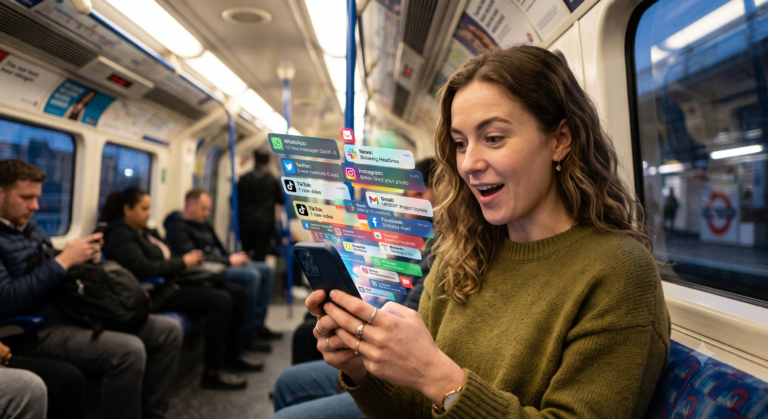
Social Media Didn’t Break Your Attention. The Whole Stack Did.
I stopped sim racing. I stopped shooting photography, too – the thing I actually trade under, Photographed by Gus. Not because I got busy. Because somewhere in the last few years, doomscrolling ate the time those things used to live in, and when I did open my camera roll next to someone else’s feed, I didn’t feel inspired. I felt like I wasn’t good enough to bother.
That’s not a metaphor. That’s what happened.
Then I checked my screen time. Three hours a day, most days, on my phone. Not working. Scrolling. I deleted the social apps – not the phone, just the apps – and inside a few weeks that number dropped to 35 minutes a day. I’m reading books again. Sim racing again. The stress dropped enough that I noticed it before I could explain it.
I’m telling you this upfront because most of what gets written about attention and social media skips the personal part and goes straight to the lecture. I’d rather show you mine first.
The blame game everyone’s stuck in
Read enough about this topic and you’ll notice everyone’s arguing past each other.
Camp one: social media is doing this to you. The algorithm is engineered to hijack your dopamine system, the feed is designed by people who studied casino mechanics, you are the product being farmed for attention. All true, to a point.
Camp two: it’s not the platform, it’s you. Discipline, willpower, personal responsibility. Delete the apps if it bothers you so much. Also true, to a point.
Here’s what bugs me about both. They’re each half a story being sold as the whole thing.
And the stat that gets dragged out to support camp one is usually fake. You’ve seen it – “humans now have a shorter attention span than a goldfish, down to 8 seconds.” It’s been repeated in keynote decks, LinkedIn posts, and content marketing articles for a decade. It came from a Microsoft Canada report from 2015, except the report never actually said that – the number traces back to a source called Statistics Brain that made the figure up, goldfish claim included. Goldfish, for the record, have been shown to retain memories for months.
If the flagship stat people use to prove attention spans are collapsing is fabricated, that tells you something about how carefully this topic tends to get handled. Not that the underlying concern is wrong – just that most of what’s written about it hasn’t earned the confidence it writes with.
What the research actually shows
The honest version is less dramatic than the goldfish line, but it’s real.
Gloria Mark, a researcher at UC Irvine, has been measuring how long people focus on a single screen before switching away – not with a survey, but by shadowing people and logging start and stop times, later replaced with software tracking. In 2004, the average was about two and a half minutes per screen. By 2012 it had dropped to about 75 seconds. Her more recent work puts it under a minute – somewhere around 47 seconds on average, with the median even lower. Independent studies from 2014 through 2020 have replicated numbers in that same range.
That’s two decades of data, not a single viral infographic.
On the content side, a 2025 meta-analysis published in Psychological Bulletin pulled together 71 studies covering 98,299 people and looked specifically at short-form video – TikTok, Reels, YouTube Shorts. Heavier use was consistently linked to weaker attention and weaker inhibitory control – the ability to stop yourself mid-impulse. The researchers’ theory: constant exposure to fast, high-reward content desensitises you to slower tasks like reading or sustained work, while sensitising you to chasing the next quick hit.
Worth saying plainly – this is correlation, not proof of a one-way cause. People who already struggle with focus may be more drawn to short-form video in the first place. The researchers say as much themselves. But the pattern is consistent enough, across enough studies and enough people, that “harmless, nothing to see here” isn’t a position the evidence supports either.
The part everyone skips: it’s not one thing
Here’s my actual argument, and it’s the reason I wanted to write this rather than just link to a study.
Nobody in this conversation seems to want to blame more than one thing at a time. It’s the algorithm, or it’s you, or lately it’s specifically short-form video as its own villain. I think that’s lazy, and I think it lets everyone off the hook for understanding what’s actually happening.
Three things are compounding here, not one:
The platforms. Feeds built to be infinite, engagement-optimised, tuned by companies with entire teams dedicated to keeping you scrolling one more time. This part is well understood and well documented. I’m not going to pretend it isn’t real.
The format. Short-form video specifically – not “social media” as a blob, but the scroll-cut-scroll rhythm of Reels and Shorts. I used to watch a lot of Instagram Shorts myself, and I’ve watched it happen in people close to me too – the difference between opening a feed of photos and opening a feed of six-second video clips is not subtle. One asks you to look. The other asks you to react, immediately, over and over. The 2025 meta-analysis backs this up – the effect size on attention was strongest for short-form video specifically, not social media use generally.
Accessibility. This is the one that gets skipped entirely, and it’s the one I think matters most. None of the above works at scale without a device in your pocket, always on, always connected, and cheap enough that almost everyone has one. Global smartphone penetration has gone from a minority technology to something like 70% of the world’s population carrying one. Devices that cost under $100 are now standard in markets that had almost no smartphone presence fifteen years ago. Mobile data got cheap enough to leave running in the background all day. The algorithm didn’t get more persuasive over the last decade so much as it got a permanent seat in your pocket, everywhere, all the time.
Take any one of those three away and the problem shrinks. A great algorithm on a device nobody owns does nothing. Constant access to a boring, non-optimised feed does far less damage. Short-form video without the infinite scroll behind it is just… video.
It’s the combination. And most of what’s written treats it like a single-variable problem because that’s easier to write a headline about.
What actually changed for me
I’m not going to tell you to delete every app and throw your phone in a drawer. I don’t think that’s realistic, and honestly, I don’t think it’s necessary.
What I did was smaller than that. I removed the social apps from my phone – not the phone itself, not the accounts, just the apps. That one piece of friction was enough. If I want to check Facebook now, I have to actually go to a browser and log in, which takes maybe thirty seconds longer than tapping an icon. That thirty seconds is doing more work than I expected.
I check Facebook once a week now, maybe five to ten minutes at a time. My total phone use dropped from around three hours a day to about 35 minutes. I started reading books again – actual books, cover to cover, not just headlines. I got back on the sim rig. The stress I didn’t fully notice I was carrying eased off before I could put a name to why.
None of that required willpower in the way people usually mean it. It required making the easy thing slightly harder, and letting that be enough.
Where to from here
I don’t think the answer is quitting social media, and I’m suspicious of anyone who tells you it is – that’s its own kind of oversimplification, just from the other direction.
The answer, at least the one that worked for me, is being honest about what’s actually pulling at your attention. Not “social media is bad,” not “you just need more discipline” – the algorithm, the format, and the phone that makes both of those things frictionless, all three, working together.
Once you see it as three things instead of one, you get more places to intervene. You don’t have to win the fight against the algorithm. You just have to make one part of the chain slightly less convenient.
Where to from here is up to you. Mine started with deleting four apps and nothing else.
FAQs
Is the “humans have an 8-second attention span, shorter than a goldfish” claim actually true? No. It’s traced back to a source called Statistics Brain, not the Microsoft report it’s usually credited to, and Microsoft’s own report never made that claim. Goldfish memory has also been shown to last months, not seconds. The underlying concern about attention isn’t baseless, but this specific stat is fabricated.
Does deleting social media apps from your phone actually help, or is it just willpower theater? Adding friction – removing the app so you have to use a browser instead of a one-tap icon – has a real, measurable effect for a lot of people because it interrupts the automatic habit loop rather than relying on discipline in the moment. It’s not a guarantee, but it worked well enough to cut phone use by roughly 80% in my own case.
Is short-form video worse for attention than other kinds of social media use?
Based on a 2025 meta-analysis of 98,299 people, yes – the association with weaker attention and inhibitory control was strongest specifically for short-form video like TikTok, Reels, and Shorts, compared to social media use more broadly. The rapid, high-reward format appears to be doing more of the damage than the platform category as a whole.
How do you know if your phone use has become a problem? Check your screen time honestly, then ask what it’s replacing. If hobbies, reading, or things you used to enjoy have quietly disappeared and you can trace that back to hours spent scrolling, that’s a clearer signal than any specific number of minutes.
Do you have to quit social media completely to fix your attention span? No. Complete abstinence works for some people but isn’t necessary for most. Smaller changes – removing apps to add friction, setting specific check-in times, being deliberate about what you follow – can produce real change without requiring you to disappear from every platform.
Why does accessible technology matter as much as the algorithm itself? Because the algorithm can’t reach you without a device in your pocket, always connected, cheap enough for nearly everyone to own. Smartphone penetration and cheap mobile data are what turned an engagement-optimised feed into something running in the background of daily life for most of the world – not just for people who choose to seek it out.